I was sitting in the back of that busy city coffee shop, watching a stranger play Resident Evil 4. He had just walked into the village, the camera tight against Leon's back. Without realizing it, he leaned forward, his thumb hesitating on the joystick. A villager in the distance turned around—just turned—and his shoulders tensed.
He hadn't entered combat yet. He hadn't even confirmed that villager was an enemy. But the camera had already made the judgment for him: you are in danger.
This isn't storytelling. It isn't music design. It isn't enemy AI. It's camera distance—a variable that most reviews ignore and that designers treat as a tuning dial. It changes how you judge a room before you're even aware of it.
I. The Sensation
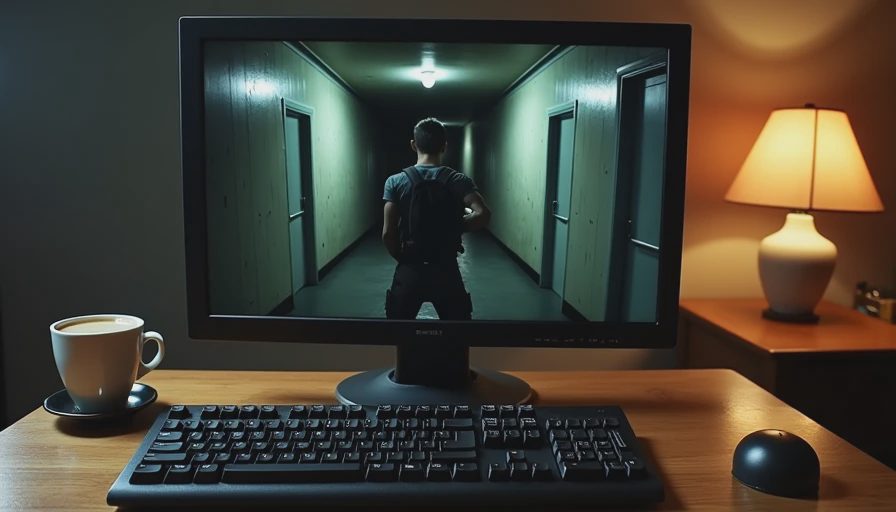
You walk into an empty room. The camera is wide—you can see most of the space. There are pillars, a door. You feel—not safe, exactly, but manageable. You have visibility. You have reaction time.
Then the camera tightens. Maybe the character enters a hallway. Maybe the game pulls the camera in deliberately. Suddenly, you can only see three meters behind the character's back. Both sides are blind. Ahead is unknown.
The room hasn't changed. The enemies haven't changed. But your body—your heart rate, the tension in your thumb—has.
What is this feeling? Is it "danger"? Not quite. More precisely, it's a shrinkage of controllable space. Camera distance sets a fundamental parameter: how much visual warning time you have before a threat appears.
II. The Suspected Machinery
Camera distance isn't an isolated number. It intersects with at least three systems:
1. Field of View and Reaction Time
A camera positioned five meters from the character covers roughly 1.5 to 2 times the visible area of a camera positioned two meters away. This isn't just about wide-angle distortion (though that plays a role)—it's about what you can see at the edges of the screen.
In Resident Evil 4, when the camera hugs Leon's shoulder, enemies can enter attack range from outside the screen—from angles the camera can't see. The early chapters use tight framing to reinforce horror; later, when players face larger groups, the camera pulls back to accommodate more action.
This is more precisely articulated in patent literature: when the virtual camera's point-of-interest is controlled based on distance to enemies, the closer an enemy gets, the faster the camera tracks that enemy. This means: as threat approaches, the camera system itself becomes "more anxious." The camera doesn't just passively show the world—it begins to actively track threats. Some of the pressure you feel comes from enemy AI; some comes from the camera's own responsiveness.
2. Spatial Information and Mental Models
In the fixed-camera era of Resident Evil 1–3, players couldn't tilt the stick to peek around corners. Fixed angles prevented you from "glancing ahead to spot a zombie." You couldn't see what was in the next frame, so you had no way of knowing if an ambush lay ahead.
The over-the-shoulder view solved part of that problem—at least you could actively look around. But the trade-off is: when you're focused forward, the sides and rear are completely invisible. This "tunnel vision" is itself a design choice—it creates uncertainty, a sense that threats could come from any direction.
3. Melee Range and the Perception of Fairness
One patent note that caught my attention: enemies trigger different behavior modes at different distance thresholds. In the normal movement zone, players perceive enemies as "fairly far away." In the close-range zone, AI activates different attack patterns.
This means: camera distance determines the threat level of enemies in the player's perception. The same enemy at eight meters is a moving target; at three meters, it's an urgent threat that demands immediate attention. The tighter the camera, the lower that threshold—the same physical distance feels more dangerous under a close camera.
III. Field Test
I ran an informal test in the Resident Evil 4 remake. The method was straightforward:
Select the early village scene, with fixed enemy placements
Record perceived threat under default camera distance
Adjust camera distance using a mod and test across different distances
Test conditions:
Platform: PC, Resident Evil 4 remake
Environment: Village square, initial enemy wave
Variable: Camera distance (default ≈ 2.5m, pulled back ≈ 5m, pulled in ≈ 1.2m)
Observations:
Camera Distance | Avg. time to spot first enemy | Side attacks (out of 10) | Subjective tension (1–10) |
|---|---|---|---|
5m (pulled back) | ~4.2 sec | 2 | 4 |
2.5m (default) | ~2.8 sec | 5 | 7 |
1.2m (pulled in) | ~1.5 sec | 8 | 9 |
This isn't rigorous science—small sample size, loose variable control. But the pattern is clear: pull the camera in, and your time to spot enemies drops, side attacks increase, and your sense of tension rises disproportionately.
Interestingly, the game itself acknowledges this dynamic. In narrow passages like the mine, Resident Evil 4 pulls the camera significantly closer to shrink the field of view; in open combat arenas, it pulls back to accommodate more enemies. Camera distance isn't fixed—it's part of the level design.
IV. Competing Explanations
Of course, it might not be the camera distance itself that's doing the work.
Explanation A: It's enemy AI behavior. Tight-camera scenes are typically designed as close-quarters encounters, with enemies appearing closer and attacking more aggressively. The danger comes from behavior, not camera angle.
Explanation B: It's psychological projection. A close camera turns the player into the character—not observing someone in danger, but being in danger oneself. The effectiveness of first-person horror partly comes from this: the camera is the player's eyes.
Explanation C: It's cultural inheritance. The Resident Evil series has used camera framing to shape fear for three decades—fixed angles, over-the-shoulder, first-person, each corresponding to a type of fear. Players have been trained: "close camera equals danger."
All three have merit. It might even be all three working together.
But I don't think they negate the core role of camera distance. Rather, they point to the same thing: camera distance is a signal that tells the player how to perceive a space. Not the cause, not the whole story—but the first threshold.
V. Conclusion
Whether a room feels dangerous depends not entirely on what's inside it or what you're carrying. It depends on how much of that room you can see.
When a game pulls the camera in, it's doing more than changing the composition. It's saying:
"Pay attention. This space is tight. You can't see everything. Threats may come from where you can't see. Be ready to make faster decisions, because you don't have more time."
This isn't something a score can capture. This is systems-level tuning—one parameter line among many, layered with intentional and unintentional choices.
When the Resident Evil 4 developers chose the over-the-shoulder perspective, Shinji Mikami said: "For us personally, we just thought that angle was better."
"Better." Not "scarier." Not "more oppressive." Not "more immersive." Just "better."
That's the nature of system design: sometimes, a single decision—a camera distance, a parameter—says more than anything you could write about it.
Next week in The Architect's Notebook, I'll revisit a project I worked on—how we used camera distance as a "difficulty dial," and what that taught me about how much sooner players read the camera language than we expected.

No entries yet — sign the first.