The scariest horror games are not necessarily the ones with the loudest screams or the most elaborate monsters. They are the games that make me distrust a hallway, count my remaining bullets, and hesitate before opening a door I have already opened twice. I used to think fear came mainly from presentation. After studying systems for long enough, I now see it as a negotiation between information, time, space, and the player's ability to recover.
That distinction matters. A scripted scare can make me jump once. A system that keeps uncertainty alive can make me uncomfortable for an hour. This is what I saw while revisiting several influential horror designs, and this is what I think it means: the scariest horror games control what the player knows without making the rules feel arbitrary.
Fear begins with incomplete information
A horror game needs to hide something, but total confusion is not automatically frightening. If I cannot understand why I died, I do not feel hunted. I feel disconnected from the game. The strongest scariest horror games give me partial information: a sound from another room, a door moving slightly, a missing item, or an enemy silhouette that disappears before I can identify it.
This creates a useful gap between observation and explanation. I know something changed, but I do not yet know whether the change is dangerous. In Alien: Isolation, sound and motion often establish a threat before the player sees the creature clearly. In Amnesia: The Dark Descent, darkness becomes more than a visual effect because it limits reliable information. The player is not simply looking at a dark screen. The player is making decisions with a damaged sensor.
I measure this kind of tension by asking three questions. What does the player know? What does the player suspect? What action would produce better information? When those answers do not line up, fear has room to grow.
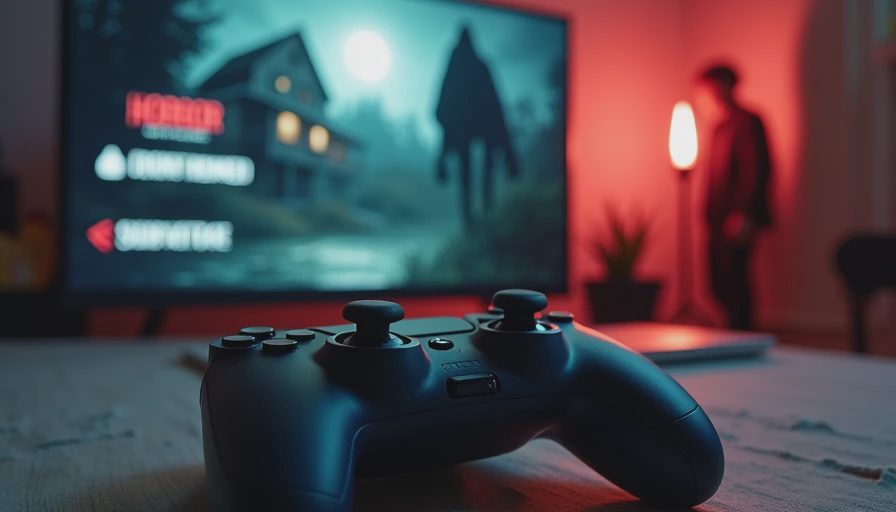
The system is not hiding. It is speaking in a language most reviews do not translate. A distant footstep is a timing signal. A limited flashlight is an attention budget. A locked door is a promise that the map will later be revisited under different emotional conditions.
Why helplessness works, and when it fails
Many of the scariest horror games reduce the player's combat power. Outlast gives the player a camera and places escape above confrontation. Amnesia makes direct violence irrelevant for much of its design. Resident Evil often gives the player weapons, but ammunition, reload time, inventory space, and enemy durability prevent those weapons from becoming complete solutions.
Helplessness works when it changes behavior rather than merely removing buttons. If a player has no attack option but can still sprint, hide, barricade a door, or manipulate the environment, the game presents a problem with readable variables. I can plan around those limits. The tension comes from choosing which resource to spend: distance, noise, time, health, or visibility.
It fails when the game removes agency without communicating the reason. A hidden instant-death attack can be startling, but repeated deaths teach me nothing except that the designer wants control. I used to make a version of this mistake. I would add a powerful enemy and assume the lack of an obvious counter would create dread. Usually it created cautious save-scumming instead.
The best scariest horror games make vulnerability specific. I know the danger is fast but noisy, or strong but easy to avoid, or blind but sensitive to movement. That knowledge does not make the threat safe. It makes my decisions meaningful.
Space turns ordinary movement into suspense
Horror depends heavily on the shape of a level. A long corridor is not frightening by itself. It becomes frightening when the player cannot see the exit, when turning around takes time, or when the route back passes through a space whose rules have changed.
The scariest horror games use spatial memory against the player. A familiar room can become threatening after a power failure, a new enemy spawn, or a sound that was absent during the first visit. Silent Hill 2 understands this transformation through fog, blocked routes, and ambiguous landmarks. The map feels less like a neutral diagram and more like a record of uncertainty.
I pay attention to recovery routes when analyzing a horror level. Where can the player retreat? How long does it take to reach safety? Is safety real, or does it only pause the threat? A safe room has mechanical value because it gives the nervous system a reset. Remove all safe spaces and the player can become numb. Place them too generously and fear loses pressure.
A well-tuned level alternates compression and release. A narrow stairwell creates proximity. A larger room gives the player options but also creates blind spots. A short return trip can be more stressful than a new area because the player already understands enough to imagine what might have changed.
Sound is a clock the player cannot see
Visual horror is easy to describe, but sound often controls the player's internal timing. A repeated scrape can establish a creature's patrol rhythm. A radio burst can warn that proximity is increasing. Even silence can function as a countdown when the player expects an audio cue that has not arrived.
The scariest horror games use sound with restraint. If every creak means danger, the signal becomes decoration. If no sound has reliable meaning, the player stops listening. Effective audio systems create a mixture of true signals, environmental noise, and unresolved cues. The player begins sorting them automatically, which is exactly when a false positive becomes powerful.
This is why headphones can change a familiar horror game. They improve directional information, but better information does not always reduce fear. It can make the threat more precise. Hearing movement behind the left wall tells me where danger might be, while withholding the exact distance forces me to act before certainty arrives.
A designer can also manipulate silence by delaying a familiar cue. If an enemy normally growls before attacking, removing that growl creates doubt. Is the enemy absent, or has the rule changed? The number of seconds is less important than the player's expectation of those seconds.
Resources create fear through future cost
A health item is not just a health item. It is a decision about future risk. Spending a medkit after minor damage may prevent a later death, but saving it may force me to cross a dangerous area while injured. Ammunition creates the same pressure. The key variable is not the exact inventory count; it is whether the player can estimate what that count must survive.
The scariest horror games make resources legible enough to support planning and scarce enough to make planning uncomfortable. Resident Evil's inventory cases turn space into a tactical puzzle. Signalis uses ammunition, storage, and backtracking to make every extra object compete for attention. These systems produce fear without needing a monster in every room.
I distinguish scarcity from inconvenience by watching player behavior. Real scarcity changes routes, combat choices, and exploration. Inconvenience simply makes the player open menus repeatedly. A resource system earns its place when the player remembers the cost after leaving the menu.
What to test when a game feels frightening
When I analyze the scariest horror games, I do not begin by asking whether the game is scary in the abstract. I record the moment fear rises and test the surrounding conditions.
First, I note the information gap: what was hidden, delayed, or contradicted? Next, I check the player's available actions and the time required to perform them. Then I map the nearest recovery point and estimate how much progress failure would erase. Finally, I compare the sound, lighting, enemy behavior, and resource state before and after the scare.
This method does not turn fear into a formula. It separates a jump scare from a durable pressure loop. It also reveals why two players can respond differently. One player may find uncertain enemy behavior terrifying, while another feels more tension from inventory limits or navigation failure.
The numbers are evidence. The experience is the conclusion. The scariest horror games work because their systems make ordinary decisions feel loaded: walk or wait, listen or move, spend or save, open the door or keep the light on. Once those choices carry a credible future cost, the game no longer needs to shout. It can whisper, and the player will supply the rest.
No entries yet — sign the first.